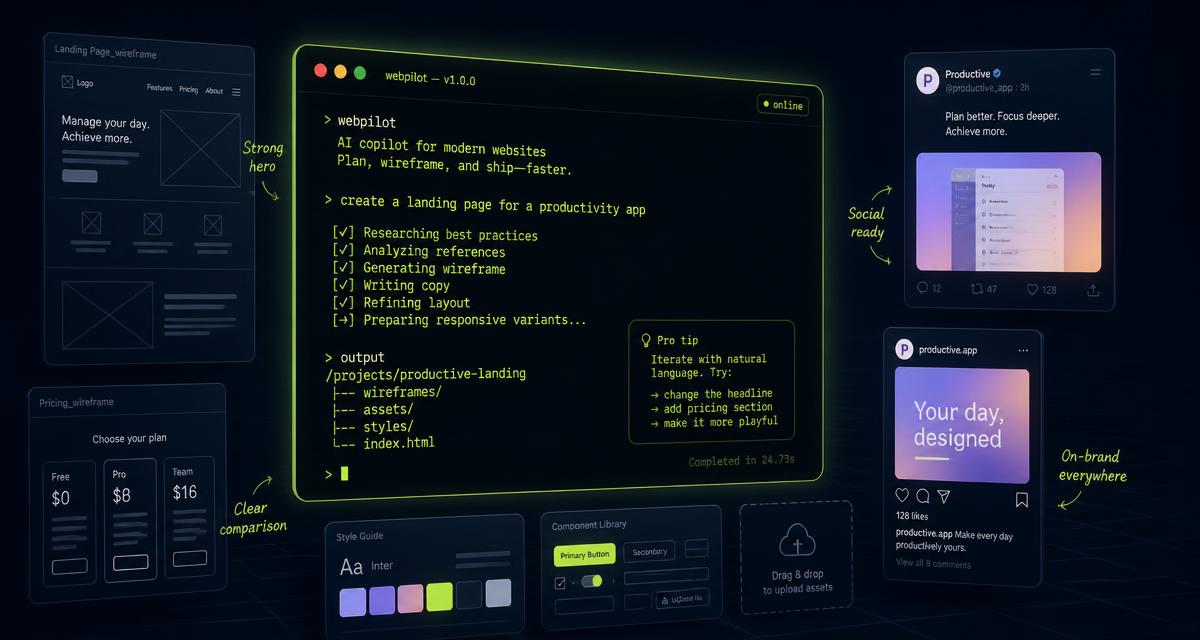
A thousand prompts is a lot of ammunition. It's worthless if you're loading it wrong. Here's the formula behind every prompt in our library, thirty-three of the best ones ready to copy, and the operating system that turns them into a month of published work instead of a folder of drafts.
Your AI output sounds like nobody because you told it nothing
Every business owner who says "AI writing is generic" is describing a real result and misdiagnosing the cause.
The model isn't guessing at your business because it's lazy. It's guessing because you asked it to write a homepage headline and gave it one noun to work with. Faced with a blank, it fills the blank with the statistical middle of every website it has ever seen. That's where "Elevate Your Wellness Journey" comes from. Nobody wrote that. It's the average of everything.
The fix isn't a better model or a magic phrase. It's information density. A prompt is a briefing document, and the same rule applies that applies to briefing a new copywriter on their first day: the quality of the output is capped by the quality of the brief. Hand a great writer three sentences of context and you get competent filler. Hand them your pricing, your five best reviews, the three objections you hear every week, and the exact thing you want a visitor to do next — now you get something usable.
The library this guide is built on contains 1,000 prompts across 32 categories, split evenly between website work and social media work. But if you took nothing from it except the six-part structure below, you'd get more out of your next AI session than a thousand copy-pasted prompts would give you.
The anatomy of a prompt that works
Every prompt in the library, from the one-line requests to the multi-step strategy prompts, is assembled from the same six parts. Here's one taken apart so you can see the joints.
- Role — Act as a conversion copywriter who has written 200+ service pages for local medical practices.
- Goal — Rewrite the hero section of my service page so a first-time visitor understands what I do and books a consult.
- Context — Business: [NAME], a [TYPE] in [CITY]. Audience: [WHO]. Offer: [SERVICE + PRICE]. Proof: [REVIEWS, YEARS, CREDENTIALS, RESULTS]. Current copy: [PASTE].
- Constraints — Headline under 10 words. Sixth-grade reading level. No hype adjectives. No claims I haven't given you.
- Format — A table: 8 headline options, the emotion each targets, and the visitor question each answers.
- Guardrail — Do not invent facts, statistics, testimonials, or credentials. Mark anything you need from me as [VERIFY].
Five of these six are things most people skip. The one almost everybody includes is Goal — "write me a headline" — which is exactly the part the model could have guessed.
The Guardrail line is the one I'd fight hardest to keep. Ask any model to write a med spa service page and it will happily produce "trusted by over 5,000 patients across Central Ohio." That number came from nowhere. It reads beautifully. It's also the kind of sentence that turns into a problem when a competitor screenshots it, or a state board asks you to substantiate it. Telling the model up front that inventing facts is off the table, and to flag gaps as [VERIFY] instead, changes the output from a first draft you have to fact-check line by line into a first draft with its own holes labeled.
Steal this skeleton for any prompt you write yourself
When you need something the library doesn't cover, build it from this. It takes ninety seconds and it outperforms almost any prompt you'll find in a listicle.
The universal prompt skeleton
Fill the brackets. Delete nothing.
Act as [ROLE with specific, relevant experience]. Help me [GOAL] for [BUSINESS TYPE] in [CITY] serving [AUDIENCE]. Context you must use: - What we sell: [OFFER, PRICING, WHAT'S INCLUDED] - Who buys it: [AUDIENCE, THEIR SITUATION, WHAT THEY FEAR] - Why us: [PROOF — reviews, years, credentials, results, guarantees] - Voice: [3 ADJECTIVES + one brand we sound like and one we don't] - Raw material: [PASTE EXISTING COPY, REVIEWS, NOTES, TRANSCRIPT] Rules: - Do not invent facts, numbers, testimonials, or credentials. - Mark anything you need from me as [VERIFY]. - Plain language. No hype adjectives. No em-dash-heavy filler. - Every claim must trace back to something I gave you. Return it as [EXACT FORMAT — table, 3 options, checklist, outline]. Before you write, ask me up to 3 questions if anything critical is missing.That last line is underrated. Letting the model ask three questions before it writes turns a monologue into a briefing call, and it surfaces the gaps in your own thinking. Half the time the questions it asks are the questions your customers are asking on your website right now with no answer in sight.
The same request, two ways
Here's what the difference actually looks like on a real task — writing an Instagram caption for a Columbus med spa promoting a Botox special.
Thin prompt
Write an Instagram caption for a med spa Botox special.
You get: an emoji-heavy caption about "unlocking your best self," five hashtags that 4 million posts already use, and a CTA that says "DM us to learn more!" It could belong to any of 30,000 med spas. It names no price, no provider, no neighborhood, and no reason to act this week.
Loaded prompt
Act as a social strategist for aesthetics practices. Write 3 Instagram captions for [SPA], a nurse-injector-owned med spa in Clintonville. Offer: $11/unit Botox through Sept 30, minimum 20 units, new patients only. Injector: [NAME], RN, 9 years, 400+ patients. Objection to answer: "will I look frozen." Voice: warm, plain-spoken, zero hype. 120–150 words. Include a first-comment hashtag set mixing 3 local and 5 niche tags. CTA: book link in bio. Do not invent results or claims.
You get: three captions that name a price, a person, a deadline, a neighborhood, and the fear that actually stops people from booking.
Same model. Same thirty seconds of generation. The only variable is how much you brought to the table.
The website prompts: 16 categories, four jobs
Five hundred of the thousand prompts are website prompts. They sort into sixteen categories, and those sixteen categories are really doing four jobs.
Below is each cluster, what it's for, and a prompt from it that's worth your time. Every one is written to be pasted as-is once you fill the brackets.
Cluster A — Foundation. Homepage strategy · Brand messaging · About page · Trust and proof
These decide whether a stranger stays past eight seconds. Most sites fail here and then blame their traffic.
Hero headline that names the outcome, not the service
Use when your homepage opens with your company name and a tagline nobody asked for.
Act as a conversion copywriter for local service businesses. Write 8 homepage hero headlines for [BUSINESS], a [TYPE] in [CITY] serving [AUDIENCE]. Rules: - Each headline names the outcome the customer wants, not the service I sell. - Under 10 words. No colons. No "Elevate," "Unlock," "Journey," or "Transform." - Assume the reader has never heard of us and is comparing 3 options. Context: [WHAT WE DO] · [WHO WE SERVE] · [WHAT MAKES US DIFFERENT] · [PROOF] Then: pick your strongest 2, explain in one sentence each why it beats the others, and write a matching subheadline (under 25 words) and button label (under 4 words) for each. Do not invent claims, numbers, or credentials.Message hierarchy — what you say first, second, third
Use before a redesign, so the design serves an argument instead of decorating one.
Act as a brand strategist. Build a message hierarchy for [BUSINESS]. Context: [OFFER] · [AUDIENCE] · [COMPETITORS] · [PROOF] · [PRICE POSITION] Return a table with 4 rows: 1. Primary claim — the one thing we own, in 8 words 2. Three support pillars — what makes the primary claim credible 3. Proof assigned to each pillar — drawn ONLY from what I gave you 4. The objection each pillar defuses Then flag any pillar where my proof is thin, and tell me exactly what evidence I'd need to collect to make it hold up.Founder story that sells instead of reminisces
Use when your About page starts with "Founded in 2002…" and loses everyone by line two.
Act as a narrative copywriter. Write my About page in 400–500 words. Raw material (use only this): [WHY YOU STARTED] · [WHAT YOU DID BEFORE] · [A MOMENT THAT CHANGED HOW YOU WORK] · [WHO YOU SERVE NOW] · [CREDENTIALS] · [SOMETHING TRUE THAT'S SLIGHTLY UNFLATTERING] Structure: open on the moment, not the year. Make the reader the beneficiary of the story, not the audience for it. End on what that history means for someone deciding today. Voice: [3 ADJECTIVES]. First person. No "passion," no "journey," no "we pride ourselves." Mark anything you need me to confirm as [VERIFY].Proof inventory — find the trust signals you already own
Use once a year. Most businesses are sitting on proof they never put on the site.
Act as a conversion researcher. I'll paste everything I have that could function as proof: [REVIEWS, RATINGS, YEARS IN BUSINESS, CERTIFICATIONS, AWARDS, CLIENT COUNT, BEFORE/AFTER RESULTS, PRESS, PARTNERSHIPS, GUARANTEES, MEMBERSHIPS]. Do three things: 1. Sort each item by persuasive strength for [AUDIENCE], strongest first, and say why. 2. Assign each to the exact page and position where it does the most work (hero, near the price, next to the form, on the objection section). 3. Name the 3 highest-value proof assets I do NOT have, and the simplest way to collect each in the next 30 days. Do not invent proof I did not list.Cluster B — Money pages. Service pages · Product pages · Landing pages · Conversion optimization
Where intent turns into revenue. Every one of these prompts assumes a visitor who is close to buying and looking for a reason not to.
Service page blueprint built from visitor questions
Use for every service you offer. One page per service, always.
Act as a senior website strategist. Plan a service page for [SERVICE] at [BUSINESS] in [CITY], aimed at [AUDIENCE]. Step 1: List the 12 questions a real buyer asks before booking [SERVICE], ordered the way they'd occur to someone who is nervous and comparing options. Include the ones people are embarrassed to ask out loud. Step 2: Map those questions to page sections in reading order. Step 3: For each section, specify: the heading, the job it does, the proof it needs, the word count, and any image or video that would carry it better than text. Step 4: Place two conversion points and justify each position. Step 5: List every fact you need from me before this page can be written. Do not write the copy yet. Do not invent facts.Objection map turned into an on-page FAQ
Use when your sales calls keep covering the same five things your site never mentions.
Act as a sales strategist. Here are the objections I hear on real calls: [LIST THEM VERBATIM, INCLUDING THE AWKWARD ONES] For each objection: - Rewrite it as the question a customer would actually type or ask. - Write a 40–70 word answer that concedes what's true before it reframes. - Name the single piece of proof that would settle it. - Say whether it belongs in the FAQ, in the body copy, or next to the price (and why — answers buried in an FAQ that belong beside the button cost sales). Rank the finished set by how often each objection kills a deal. Answer honestly. If an objection is legitimate, say so and tell me what to fix in the business rather than in the copy.Landing page for one offer and one action
Use for every paid campaign. Never send ad traffic to your homepage.
Act as a direct response copywriter. Write a landing page for a single offer: [OFFER, PRICE, WHAT'S INCLUDED, DEADLINE, WHO QUALIFIES]. Traffic source: [PLATFORM]. The ad said: [PASTE AD COPY]. Audience temperature: [COLD / WARM / RETARGETING]. The page must: match the ad's promise in the first 5 words, carry exactly one call to action repeated 3 times, and remove every link that isn't that action. Sections: hero · what you get · who it's for and who it isn't · proof · objection handling · offer terms · final CTA. Constraints: no navigation, no "learn more," no second offer. Sixth-grade reading level. Deadline stated plainly, never faked. Flag any claim I need to substantiate as [VERIFY].Conversion audit of a page you already have
Use before you rewrite anything. Half the time the copy is fine and the path is broken.
Act as a conversion optimization specialist. Here is my page: [PASTE FULL COPY, or the URL and a description of the layout in reading order]. Audit it in this order: 1. In 5 seconds, what does this page promise, to whom, and what does it want? Answer as a first-time visitor on a phone, honestly. 2. List every point of friction: unclear labels, buried price, missing proof, competing CTAs, jargon, forms asking for more than they need. 3. Score clarity, credibility, and urgency out of 10 with reasons. 4. Give me a prioritized fix list: 5 changes I can make today, 3 that need a designer, 1 that needs a business decision. 5. Rewrite only the single highest-impact element. Be blunt. Do not compliment anything that doesn't deserve it.Cluster C — Findability. SEO foundations · Blog and resource content · Local business pages · E-commerce experience
Getting found by Google, by AI answer engines, and by the person typing "near me" at 9pm.
Turn a keyword pile into a page architecture
Use when you have a keyword list and no idea how many pages it should become.
Act as a technical SEO strategist. Here are my keywords: [PASTE LIST WITH VOLUME AND DIFFICULTY IF YOU HAVE IT]. My business: [TYPE] in [CITY]. Existing pages: [LIST URLS AND WHAT EACH TARGETS]. 1. Cluster the keywords by search intent, not by string similarity. 2. For each cluster, decide: existing page, new page, or blog post — and say which existing page, or why a new one is needed. 3. Flag every case where two of my pages would compete for the same intent, and tell me which to keep and which to merge or redirect. 4. Assign one primary and up to three secondary terms per page. 5. Output as a table: cluster · intent · page type · target URL · primary term · what the page must prove to rank. Do not invent search volumes. If I didn't give you a number, leave it blank.Blog brief that answers a real question
Use instead of "write me a 1,000 word blog post about X."
Act as a content strategist. Build a brief — not the article — for a post answering: "[EXACT QUESTION A CUSTOMER WOULD ASK]" Include: - The searcher's situation in 2 sentences: what happened right before they typed this, and what they're afraid of. - A direct 40-word answer that could stand alone at the top of the page. - An H2/H3 outline where each heading is a sub-question. - The specific expertise, data, or first-hand experience I must supply for this to beat what's already ranking. - 3 internal links from my existing pages: [LIST THEM]. - One thing every competing article gets wrong or leaves out. - The single next step the reader should take, and where it goes on the page. Do not write the post. Do not invent statistics or studies.Local page that isn't a find-and-replace of the last one
Use for neighborhood and city pages. Thin duplicates get filtered; specific ones rank.
Act as a local SEO specialist. Plan a page targeting "[SERVICE] in [NEIGHBORHOOD/CITY]" for [BUSINESS]. What I can tell you about this area: [LANDMARKS, DRIVE TIME FROM OUR LOCATION, PARKING, WHO LIVES THERE, CLIENTS WE ALREADY SERVE THERE, LOCAL EVENTS, SEASONAL PATTERNS]. Build a page outline where at least 60% of the content could NOT be reused for a different neighborhood. Specify: - What genuinely differs about serving customers here - Which local proof to feature and where - The NAP, service area, and hours block placement - Which schema types this page should carry and why - The 5 questions someone in this specific area would ask Tell me plainly if I don't have enough local substance to justify this page. A thin duplicate is worse than no page.Product descriptions that answer the return-risk question
Use for e-commerce catalogs where every description reads like a spec sheet.
Act as an e-commerce copywriter. Write descriptions for: [PRODUCT NAMES, SPECS, MATERIALS, SIZES, PRICE, WHAT'S IN THE BOX]. For each product return: - A 15-word summary for category listings - A 90-word description leading with the problem it solves - 5 scannable bullets: 3 benefits, 2 honest limitations - The "who this isn't for" line - 3 questions a buyer would ask before checkout, answered in one line each Rules: every claim maps to a spec I gave you. No superlatives without a number behind them. Write the limitations as plainly as the benefits — buyers trust a description that admits something. Do not invent materials, dimensions, certifications, or origin.Cluster D — Craft and upkeep. UX and navigation · Visual design direction · Maintenance and audits · Advanced strategy
The unglamorous work that decides whether the first three clusters survive contact with a real visitor.
Navigation labels tested against real intent
Use when your menu says "Solutions" and nobody knows what you sell.
Act as an information architect. My current navigation: [PASTE LABELS AND STRUCTURE]. My pages: [LIST]. My audience: [WHO]. 1. For each label, say what a first-time visitor would expect to find, and whether that matches what's actually there. 2. Flag every label that is internal jargon, a category we invented, or a word that requires knowing us already. 3. Propose two alternative structures: one organized by what we sell, one by what the visitor is trying to do. Give the trade-offs of each. 4. Recommend one, with the reasoning. 5. Tell me what to remove. Most menus have 3 items too many.Visual direction brief you can hand a designer
Use before a redesign so "make it pop" never enters the conversation.
Act as a creative director. Write a visual direction brief for [BUSINESS], a [TYPE] in [CITY] serving [AUDIENCE] at a [PRICE POSITION] price point. Include: - The feeling a visitor should have in the first 3 seconds, in plain words - Three competitors or adjacent brands to move toward, and three to avoid, with the reason for each - Palette direction with the emotional rationale — not just hex codes - Type pairing direction: what the display face should communicate, what the body face must do for readability at small sizes - Photography direction: what we shoot, what we never use stock for - Three things this design must NOT look like - What to spend the visual budget on, and where to be plain Constraint: everything must survive being viewed on a 5-year-old Android phone in daylight. Judge every recommendation against that.Quarterly content audit and prune list
Use every 90 days. Deleting weak pages usually lifts the rest.
Act as a content auditor. Here's my page inventory with traffic, conversions, and last-updated dates: [PASTE]. Sort every page into one of four buckets and justify each: - KEEP — performing, leave alone - IMPROVE — has potential, name the single change that would unlock it - MERGE — competing with another page, say which survives and what redirects - DELETE — costing crawl budget and credibility, say what to redirect it to Then give me an execution order by effort-to-impact ratio, and flag anything that must not be touched without a redirect plan. If the data I gave you is insufficient for a call, say so instead of guessing.Advanced: the whole site, argued from scratch
Use once, at the start. This is the prompt that replaces a discovery meeting.
Act as a senior website strategist for a [TYPE] business in [CITY]. Everything I know: [BUSINESS MODEL] · [SERVICES AND PRICES] · [AUDIENCE SEGMENTS] · [COMPETITORS] · [PROOF] · [CURRENT SITE AND ITS PROBLEMS] · [GOALS AND HOW WE MEASURE THEM] · [WHAT WE CAN'T CHANGE] Produce a complete site plan: 1. The single business goal this site exists to serve 2. Full page architecture with the job of each page in one sentence 3. Conversion path for each audience segment, entry point to booked action 4. Which pages carry SEO weight, which carry AEO weight, which convert 5. Trust architecture — where proof appears across the journey 6. Schema and structured data plan by page type 7. Measurement plan: the 5 numbers that tell us it's working 8. Build order by revenue impact 9. Every assumption you made that I need to confirm 10. The three riskiest parts of this plan and what would break them Challenge my weak assumptions before you build the plan. If something I told you doesn't add up, say so first.The social prompts: 16 categories, three jobs
The other five hundred prompts handle social media. Same principle, faster clock.
Social punishes vagueness harder than websites do, because there's no navigation to rescue a confused visitor and no second chance at a first line. These are grouped by what they actually do for you rather than by platform, because the platform is the last decision you make, not the first.
Cluster E — Strategy and voice. Content strategy · Brand personality · Repurposing · Analytics and improvement
Content pillars from your actual business, not a template
Use once a quarter. Everything else in social hangs off this.
Act as a social media strategist for [TYPE] businesses. Context: [WHAT WE SELL] · [WHO BUYS] · [WHAT THEY DON'T UNDERSTAND ABOUT OUR CATEGORY] · [WHAT MAKES US DIFFERENT] · [WHAT WE CAN ACTUALLY PRODUCE EVERY WEEK — be realistic about time, staff, and comfort on camera] Build 4–5 content pillars. For each: - Name and one-sentence purpose - The business goal it serves (awareness / trust / leads / retention) - 8 specific post ideas drawn from MY context, not generic category ideas - The format that fits it best and why - How I'll know it's working Then give me a weekly ratio across pillars and defend it. Finally: name the one pillar most businesses like mine skip, and what it costs them.Reverse-engineer your own voice from what you've already posted
Use once. Then paste the resulting guide into every future prompt.
Act as a brand voice analyst. Here are 15 things I've written that sound like us: [PASTE POSTS, EMAILS, TEXTS TO CLIENTS, ANYTHING IN YOUR REAL VOICE]. Here are 3 that don't sound like us: [PASTE]. Produce a voice guide: - 5 traits with a one-line definition of each - Sentence rhythm and typical length - Words and phrases we use; words and phrases we never use - How we handle humor, bad news, and pricing - Our relationship to the reader — expert, peer, guide, host? - A 60-word sample paragraph in this voice on a neutral topic Then compress the whole thing into a 100-word block I can paste into future prompts as a voice instruction.One asset into twelve pieces
Use after any blog post, video, webinar, or long client conversation.
Act as a content repurposing specialist. Source material: [PASTE THE BLOG POST, TRANSCRIPT, OR NOTES]. Voice guide: [PASTE YOURS]. Produce 12 distinct pieces from this, no overlap: - 1 Instagram carousel (hook slide + 6 slides, text only) - 2 Reels/TikTok scripts (hook in first 3 seconds, 25–40 seconds each, written to be read aloud by a real person, not narrated by a robot) - 1 LinkedIn post with a point of view, not a summary - 2 Facebook posts, one informational, one community-facing - 3 X/Threads posts that stand alone - 1 email subject line + 80-word body - 1 short FAQ answer for the website - 1 Pinterest pin title + description Rules: each piece works without the others. No piece is a summary of the source — each makes one point completely. Keep every claim traceable to the source. Flag anything the source doesn't support.Monthly analytics review that changes next month
Use on the first of the month with real numbers pasted in.
Act as a social media analyst. Here's last month's data: [PASTE REACH, ENGAGEMENT, SAVES, SHARES, PROFILE VISITS, LINK CLICKS, FOLLOWER CHANGE, AND THE TOP AND BOTTOM 5 POSTS WITH THEIR TOPICS AND FORMATS]. Business goal: [LEADS / BOOKINGS / AWARENESS / RETENTION]. 1. What actually happened — in plain language, no dashboard-speak. 2. Which metrics matter for my goal and which are vanity here. Be specific about why. 3. Find the pattern in the top 5 and the pattern in the bottom 5. Separate correlation from coincidence, and say which you're looking at. 4. Three changes for next month, ranked by expected impact. 5. One thing to stop doing entirely. If the sample is too small to support a conclusion, say so. Don't manufacture insight from 12 posts.Cluster F — Platforms. Instagram · Facebook · LinkedIn · TikTok and short video · YouTube · Pinterest · X and Threads
Instagram carousel that earns the swipe
Use for educational content. Carousels still out-save every other static format.
Act as an Instagram content creator for [TYPE] businesses. Build a 7-slide carousel on: [TOPIC]. Audience: [WHO AND WHAT THEY BELIEVE RIGHT NOW]. Voice: [PASTE VOICE BLOCK]. Slide 1: a hook that creates a specific curiosity gap — not a question anyone can answer without swiping. Under 12 words. Slides 2–6: one idea each, under 30 words, written so slide 6 is worth reaching. Give each slide a visual instruction for my designer. Slide 7: the action, stated once, plainly. Then: a 120–150 word caption that adds something the slides don't say, and a hashtag set of 3 local + 5 niche + 2 broad, formatted for the first comment. No emoji walls. No "save this post!!" Do not invent statistics.Short-video hooks, ten ways
Use when the video is fine and nobody watches past second two.
Act as a short-form video strategist. My video covers: [TOPIC AND THE ONE THING THE VIEWER LEARNS]. Audience: [WHO]. Platform: [TIKTOK / REELS / SHORTS]. Speaker: [WHO'S ON CAMERA AND HOW COMFORTABLE THEY ARE]. Write 10 opening hooks, each under 8 words, using a different mechanism: contradiction, cost of inaction, insider knowledge, common mistake, direct address, before/after, question the audience already has, myth correction, specific number, unfinished statement. For each: the mechanism, why it fits this topic, and the visual on screen during it. Then rank all 10 for this specific audience and explain your top pick. Then write the 30-second script for the winner, in spoken language, with the beat where the viewer decides to stay marked.LinkedIn post with a spine
Use when you have an actual opinion. Don't use it when you don't.
Act as a B2B content writer. Write a LinkedIn post from this: [THE THING THAT HAPPENED — a client situation, a decision you made, a result, a mistake]. Requirements: - Take a real position that a reasonable person could disagree with - Open with the specific, not the abstract. First line under 12 words. - 150–250 words, short paragraphs, no bullet-point soup - Include what it cost or what you got wrong - End with a genuine question, not "thoughts?" - Anonymize any client detail: [WHAT MUST STAY PRIVATE] Never use: "I'm humbled," "game-changer," "let that sink in," "here's the thing," or a one-word paragraph for emphasis. Do not invent numbers. If the story needs a result I didn't give you, ask.YouTube script with chapters and a real retention plan
Use for anything over three minutes. YouTube is a search engine, treat it like one.
Act as a YouTube strategist. Topic: [SUBJECT]. Target search: "[WHAT SOMEONE TYPES]". Length: [MINUTES]. Audience: [WHO AND THEIR LEVEL]. Deliver: 1. Five title options under 60 characters, each promising a specific payoff 2. A 20-second intro that states what they'll get and why me, no cold open monologue 3. Chapter outline with timestamps and the retention risk at each transition 4. Full script in spoken language — contractions, short sentences, room to breathe 5. Two places to place a genuinely useful mid-roll ask 6. Description with the first 150 characters written for search 7. Ten tags and three thumbnail concepts with the text overlay for each Constraint: everything I claim must come from [MY EXPERIENCE / DATA I GAVE YOU]. Mark anything else as [VERIFY].Pinterest and visual search set
Use for anything with a strong before/after or a step-by-step. Wildly underused by local businesses.
Act as a Pinterest strategist. Source content: [BLOG POST / SERVICE / BEFORE-AND-AFTER / GUIDE]. Business: [TYPE] in [CITY]. Produce 5 pin variations, each targeting a different search intent: - Pin title under 40 characters, keyword-forward - 100-word description written for search, not for personality - The image concept, including the text overlay and why it reads at thumbnail size - The board it belongs on - The exact landing page it should point to Then: 3 board names I should create, and the keyword each one owns. Explain which of the 5 intents is most likely to convert for a local business and why.Cluster G — Local, offers and community. Local social · Offers and promotions · Engagement and community · Social proof · Advanced
Local content that only your business could post
Use monthly. This is the moat national competitors can't cross.
Act as a local marketing strategist for [BUSINESS] in [CITY/NEIGHBORHOOD]. What's true about here right now: [SEASON, WEATHER, LOCAL EVENTS, SCHOOL CALENDAR, TRAFFIC PATTERNS, WHAT LOCALS COMPLAIN ABOUT, NEARBY BUSINESSES WE ACTUALLY KNOW, LANDMARKS, WHAT THE AREA IS PROUD OF] Generate 15 post ideas that a competitor in another city literally could not copy. For each: the idea, the format, the local detail that makes it un-copyable, and the caption angle. Rules: no "Happy National Donut Day." No borrowed civic pride we haven't earned. Nothing that requires pretending we're more embedded in the neighborhood than we are. Then flag which 3 would work as a recurring monthly series.Promotion that doesn't read as desperate
Use for every offer. The difference between a sale and a fire sale is framing and honesty.
Act as a promotional copywriter. Offer: [WHAT, PRICE, REGULAR PRICE, WHAT'S INCLUDED, WHO QUALIFIES, REAL DEADLINE, ANY FINE PRINT]. Write 3 versions of the announcement post: - Version A leads with the value, not the discount - Version B leads with the reason the offer exists (be honest — new provider, slow season, new equipment, capacity we want to fill) - Version C leads with who it's specifically right for, and names who should skip it Each 100–150 words with a clear next step and the terms stated plainly. Then: 3 follow-up posts for the deadline run-up that don't repeat the first post, and the one line that must appear in all of them. Never fake scarcity. If the deadline can move, don't say it can't. If spots aren't limited, don't say they are.Turn a review into a post without turning a client into content
Use with permission, always. Especially in healthcare and aesthetics.
Act as a social proof strategist for a [TYPE] business. Here's the review: [PASTE]. Permission status: [WHAT THEY AGREED TO]. Regulatory context: [ANY RULES THAT APPLY TO MY INDUSTRY — HIPAA, state board advertising rules, platform policy]. 1. Identify the single most persuasive sentence and say what objection it defuses. 2. Write 3 post treatments: quote card, story format, and a post where the review supports a broader point rather than being the point. 3. For each, specify exactly what must be removed or generalized to protect the client's privacy. 4. Write the permission request message I should send before publishing. 5. Flag anything in this review I should NOT amplify — outcome claims, medical specifics, comparisons to other providers. Do not embellish the review or clean up the client's wording beyond removing identifying detail.Comment and DM response bank
Use once, then hand it to whoever runs the inbox. Response speed is a ranking factor for humans.
Act as a community manager. Business: [TYPE]. Voice: [PASTE VOICE BLOCK]. Build a response bank covering: - "How much is it?" (we [DO/DON'T] post pricing because [REASON]) - "Do you take insurance / do you have financing?" - Compliments — three ways to respond without a wall of hearts - A vague complaint in public - A specific, legitimate complaint in public - A complaint that's wrong on the facts - A DM that should become a booking - A DM asking for advice we can't give over Instagram - Spam, bots, and lead-gen pitches For each: 2–3 response variations, when to move it to DM or phone, and the line we never cross in public. Add the 5 phrases that make a business sound defensive, and what to say instead.Advanced: a full 30-day calendar with production reality built in
Use at the end of every month. This is the prompt that ends the 11pm scramble.
Act as a social media director. Build a 30-day calendar for [BUSINESS]. Inputs: [PILLARS FROM S01] · [VOICE BLOCK FROM S02] · [PLATFORMS AND POSTING FREQUENCY] · [PROMOTIONS AND DATES] · [LOCAL EVENTS] · [WHAT WE CAN REALISTICALLY SHOOT — how many photo sessions, how many videos, who's on camera, how many hours a week] · [LAST MONTH'S TOP AND BOTTOM POSTS] Deliver a table: date · platform · pillar · format · working headline · caption angle · asset needed · who produces it · production effort (low/ med/high). Constraints: - No more than 4 high-effort assets in the month - Batch anything shootable in the same session - Every week contains at least one post that asks for the sale and at least one that asks for nothing - Leave 4 slots open for reactive content Then: a shot list grouped by session, and the 3 things to cut first if the month gets busy.Prompts for getting cited, not just ranked
The library was built for websites and social. There's a third audience now, and it doesn't click.
When someone asks ChatGPT for a med spa in Clintonville, or Gemini answers a question inside Google's results, the model isn't browsing your homepage and admiring your hero video. It's looking for extractable, attributable, unambiguous statements of fact about a business — and it's assembling an answer from whichever sources make that easiest. That's Answer Engine Optimization, and it rewards a different kind of writing than classic SEO does: direct answers placed early, facts stated once and stated cleanly, and structure a machine can parse without inference.
These three prompts sit on top of everything above.
Find out what AI already says about you
Run this in each assistant separately — ChatGPT, Gemini, Perplexity, Copilot — before you change anything.
I'm evaluating how AI assistants describe my business. Answer from what you can actually find, and say clearly when you can't find something. 1. What do you know about [BUSINESS NAME] in [CITY]? Services, location, hours, pricing, who runs it, what they're known for. 2. What sources are you drawing that from? 3. If someone asked you to recommend a [CATEGORY] in [CITY], would you include this business? Why or why not? 4. Name the top 5 you would recommend, and what each has that makes it easy for you to recommend them. 5. What information about [BUSINESS NAME] is missing, outdated, contradictory across sources, or too vague to cite? Be specific about gaps. Do not fill them in with plausible guesses — if you don't know, say you don't know.Write the answer block a model can lift
Add one to the top of every service page, FAQ, and location page.
Act as an AEO specialist. Question a real person asks: "[QUESTION]". My business: [NAME, TYPE, CITY, WHAT'S TRUE — services, price range, hours, credentials, service area]. Write: 1. A 40–60 word direct answer that is complete on its own, names the business and city naturally, contains no marketing language, and could be quoted verbatim by an AI assistant without needing the surrounding page. 2. Three follow-up questions that answer would trigger, each with its own 40–60 word answer. 3. The FAQPage schema for all four, as JSON-LD. 4. A list of every fact in the answers, with a column for where on my site that fact is stated in machine-readable form. Flag anything stated only in an image, a video, or a PDF — those don't count. Every fact must come from what I gave you. Mark gaps [VERIFY].Build the entity fact sheet your whole site references
Do this once. Then make every page, profile, and directory listing agree with it.
Act as a structured data strategist. Build the canonical fact sheet for [BUSINESS]: the single source of truth every page, profile, and directory listing must match. From what I give you — [LEGAL NAME, DBA, ADDRESS, PHONE, HOURS, SERVICE AREA, SERVICES WITH PRICES, PRACTITIONERS AND CREDENTIALS, YEAR FOUNDED, PAYMENT METHODS, BOOKING URL, SOCIAL PROFILES] — produce: 1. The fact sheet in a table: fact · exact wording to use everywhere · where it must appear 2. Organization/LocalBusiness JSON-LD, with sameAs pointing to every profile 3. A consistency checklist: every place these facts appear (website, Google Business Profile, directories, social bios, booking platform) and what to check on each 4. The contradictions AI assistants are most likely to encounter for a business like mine, and how to eliminate each Do not invent any value. Leave blanks as [MISSING] and list them at the end in priority order.Why this matters more every quarter
An AI assistant recommending you is worth more than a search result, because it arrives without competitors listed beside it. It's also harder to earn and easier to lose: one outdated phone number across three directories is enough to make a model hedge and recommend somebody else. Consistency isn't a nice-to-have here — it's the whole mechanism.
A thousand prompts won't help you. A sequence will.
The failure mode with a big prompt library isn't a bad prompt. It's opening the library on a Tuesday, running nine prompts in an hour, generating forty pages of output, and publishing none of it. Volume feels like progress and produces nothing.
Here's the order we actually run it in, compressed to thirty days. Week one produces no public content at all, and that's the point — everything after it inherits the context you build here.
Week 1
Load the context
- Run S02 to build your voice block
- Run W04 to inventory your proof
- Run A03 to build the fact sheet
- Run W02 for message hierarchy
- Save all four in one document. This is now your context library.
Week 2
Fix the money pages
- Run W08 on your top-traffic page
- Run W06 from your real sales calls
- Run W05 for your best-margin service
- Ship one page. One. Fully finished, in your voice, fact-checked.
Week 3
Build the social engine
- Run S01 for pillars
- Run S10 for local ideas
- Run S14 for the calendar
- Batch-shoot everything the calendar needs in one session
Week 4
Publish, measure, prune
- Schedule the month
- Run A01 in four assistants and log what they say
- Run A02 on your three most-asked questions
- Run S04 against real numbers and cut one thing
Then it repeats, minus week one. The context library you built on day one gets pasted into every prompt from then on, and the output quality jumps permanently — not because the prompts got better, but because the model finally knows who it's writing for.
The one habit that matters
Keep every prompt that produced something you actually published. Not the output — the prompt. Within two months you'll have twenty prompts tuned to your business that beat any library, including ours, because they carry your context baked in.
Seven mistakes that ruin the output
1. Asking for the finished thing first
"Write my homepage" skips every decision that determines whether the homepage works. Ask for the plan, argue with the plan, then ask for the copy. The two-step beats the one-step every single time.
2. Starting a fresh chat for every task
Context is the whole ballgame. Work in one long thread per project, or paste your context library at the top of every prompt. A model that already knows your voice, your proof, and your audience writes better on its fifth task than its first.
3. Accepting the first output
The first response is a draft to react to, not a deliverable. "Cut this by 40% and lose the adjectives" costs you eight seconds and improves almost everything. So does "now write the version you'd write if you disagreed with me."
4. Never telling it what you don't want
Negative constraints do more work than positive ones. Banning "elevate," "unlock," "journey," "seamless," "in today's fast-paced world," and the word "solutions" will improve your output more than any amount of describing your ideal tone.
5. Letting it invent proof
Models fill gaps with plausible-sounding specifics. In a regulated field — medical, aesthetics, legal, financial — that's not a style problem, it's a liability. Every prompt in this guide carries a no-invention line. Keep it there.
6. Publishing without a human pass
The last 10% is where the voice lives, and it's the only part a reader remembers. AI gets you to 90% in four minutes instead of four hours. That's a real win. It's not a finished piece.
7. Confusing volume with a strategy
Forty posts generated on a Tuesday and scheduled without a pillar behind them will underperform eight posts that each do a job. The prompts make production cheap. Cheap production is only an advantage if the thinking upstream is sound.
What AI never ships without a human
We run this workflow across a couple hundred client accounts, a lot of them in medical aesthetics, wellness, and healthcare. Some of it never goes out unreviewed, and the list is short enough to memorize.
- Any medical, clinical, or outcome claim. Not "results may vary" territory — the claim itself. A licensed provider reviews it or it doesn't publish.
- Anything with a patient or client in it. Written permission first, identifying detail removed second, publish third. Reversing that order is how practices end up in front of a board.
- Numbers. Every statistic, price, percentage, and year gets traced to a source you can point at. If it came from the model, it doesn't exist.
- Comparisons to named competitors. Legally fraught and rarely worth it. Compare to categories, not to businesses down the street.
- Anything referencing a law, regulation, or licensing requirement. These change, models lag, and being confidently wrong about a regulation is expensive.
- Crisis, complaint, and bad-news communication. Draft it with AI if it helps you organize the thought. Send it in a human voice, after a human decision.
The rule underneath all of them
AI can write anything you can verify. It should never write anything you can't. That single line will keep you out of nearly every trouble spot this technology creates for a small business.
The prompts aren't the asset
Here's the part that doesn't sell a download: a thousand prompts is not a competitive advantage, because your competitor can have the same thousand by Thursday.
What can't be copied is what you put into them. Your pricing. The reason you started. The objection you've heard four hundred times and finally know how to answer. The review from the client who cried in your office. The nine years your injector has been doing this. The fact that you're twelve minutes from Clintonville and open on Saturdays.
Those details are the whole difference between AI output that sounds like a business and AI output that sounds like your business — and they're sitting in your head right now, unwritten, which is exactly why your homepage sounds like everyone else's.
So if you do one thing after reading this, don't run a prompt. Open a document and spend forty-five minutes writing down everything true about your business that a stranger couldn't know. Your prices. Your proof. Your objections. Your voice. The reason someone should pick you over the place with the nicer parking lot.
That document is the asset. The thousand prompts are just the machine you feed it into — and once you've built it, the machine gets faster every month while everyone else is still starting from scratch on a Tuesday night.
That's the whole trick. It's not a very good secret, which is why we're comfortable publishing it.
Or skip the forty-five minutes and let us build it with you
We've been doing this for Columbus businesses since 2002, and running AI-assisted content systems for a couple hundred of them since well before it was a bullet point on everyone's services page. Websites that load in under a second, SEO and AEO built in from day one, and content that sounds like you wrote it — because the context we feed the machine came out of a conversation with you.
Joey Stardust writes about web design, SEO, and answer engine optimization for The Real Social Company in Columbus, Ohio. Questions about anything in this guide? Call 614-482-2126 or email info@therealsocialcompany.com.
Frequently asked questions
Do I need to use all 1,000 prompts?
No — and trying to is the most common way people waste the library. Most businesses run well on about fifteen prompts they've tuned to their own context. The thousand exists so that when you hit an unusual task at 4pm on a Friday, something in there already covers it. Start with the four in week one of the operating system above and add prompts only when a real task demands one.
Which AI should I use these with — ChatGPT, Claude, Gemini, or Copilot?
All of them handle these prompts. The structure matters far more than the model. That said, the differences are real enough to exploit: run the same strategy prompt in two assistants and compare, because where they disagree is usually where your brief was ambiguous. For the AEO audit prompt specifically, run it in all four separately — the whole point is finding out what each one says about you, and they say different things.
Will AI-written content hurt my Google rankings?
Google's position is that it rewards helpful, original content regardless of how it was produced, and penalizes content produced primarily to manipulate rankings. In practice that means unedited AI output published at volume is a genuine risk, and AI-assisted content that carries real expertise, real specifics, and a human editorial pass is not. The differentiator is whether the page contains something a reader can't get from the other nine results — and that something almost always comes from you, not the model.
How do I stop AI from making things up about my business?
Three things, in order of impact. First, give it the facts — most invention is gap-filling, and a well-loaded prompt has fewer gaps to fill. Second, include an explicit instruction not to invent facts, statistics, testimonials, or credentials, and to mark anything missing as [VERIFY]. Third, check every number before it publishes. The first two reduce the problem dramatically. Only the third eliminates it.
What's the difference between SEO and AEO, and do these prompts cover both?
SEO optimizes for a ranked list of links a person clicks. AEO — answer engine optimization — optimizes for being the source an AI assistant quotes when it answers a question directly, with no click involved. The tactics overlap but don't match: AEO leans much harder on direct answers placed early, unambiguous factual consistency across every profile and directory, and structured data a machine can parse. The website prompts in this guide cover SEO throughout, and section six covers AEO specifically.
How long does it take to see results from this?
Different clocks for different work. Conversion fixes on an existing page can move within days, because you're changing what already-arriving traffic sees. Social builds compound over roughly 90 days of consistent publishing. SEO and AEO typically show meaningful movement in 60 to 120 days depending on your competition and your starting point. The one thing that's immediate is production speed — the month you stop staring at a blank calendar on Sunday night.
Can I use these prompts in a regulated industry like healthcare or aesthetics?
Yes, with the guardrails in section nine treated as non-negotiable. Use AI for structure, first drafts, question mapping, and repurposing. Never let it originate a clinical claim, publish a patient detail without written permission, or state a number you can't source. Every prompt here includes a no-invention instruction for exactly this reason — but the instruction is a safety net, not a substitute for a licensed human reading the thing before it goes live.
Should I still hire an agency if I have a prompt library?
Honestly, plenty of businesses shouldn't. If you have a few hours a week, a clear head for your own positioning, and the discipline to publish on a schedule, this guide is most of what you need. Where an agency earns its keep is the part prompts don't touch: technical build and site speed, schema implementation, migration without losing rankings, sustained execution when your actual job gets busy, and someone accountable for the numbers going up. If the bottleneck is knowing what to write, you can solve that yourself. If the bottleneck is time or infrastructure, you can't prompt your way out of it.
How do I keep every post from sounding the same after a few months?
Rotate the source material, not the prompts. The sameness comes from feeding the machine the same three facts forever. Bring it new raw input — a client conversation, a question from a consult, a mistake you made, a thing that changed in your industry — and vary the format assignment across your pillars. Also worth doing quarterly: rerun the voice analysis prompt on what you've actually published lately, because your voice drifts and the guide should drift with it.
Where can I get the full 1,000-prompt library?
It's a free download from The Real Social Company — 500 website prompts and 500 social media prompts across 32 categories, organized the way this guide describes. Request a copy here or call 614-482-2126. If you'd rather have someone run the system for you, the free consultation is a better use of your time than the download.